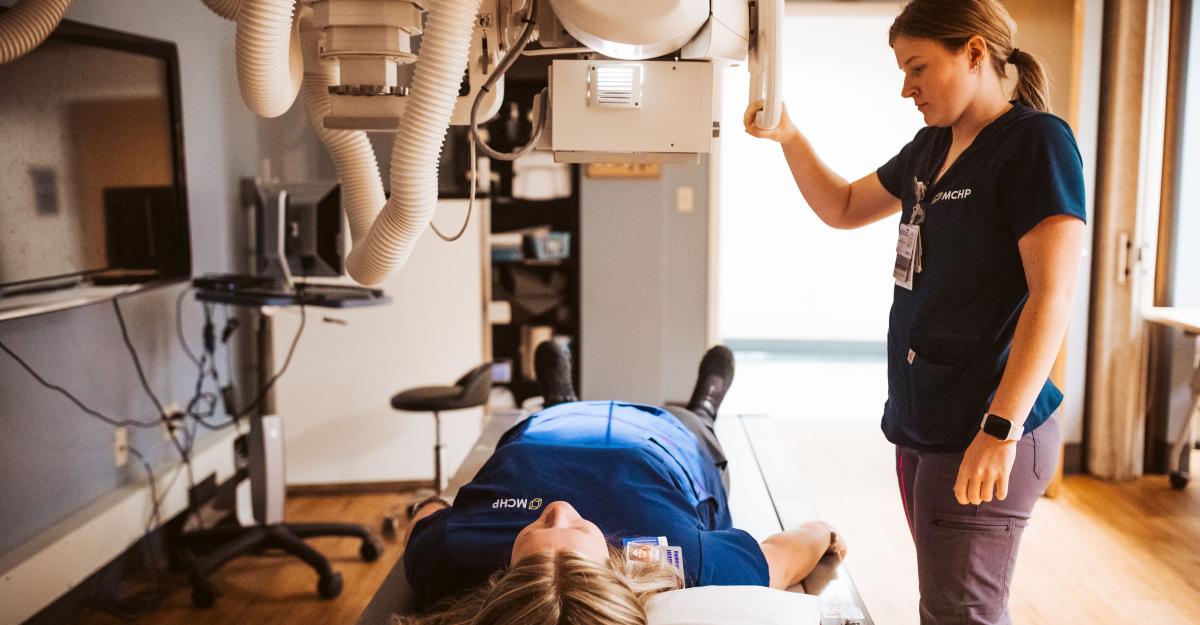
The Clark F. Miller Radiologic Technology Program at the Maine College of Health Professions offers a challenging and rewarding career educational opportunity. The College’s two-year associate of applied science degree program provides instruction and clinical experience through a blend of classroom and clinical education.
The Program begins in August each year. Students attend the College on a full-time basis, with classes and clinical rotations consisting of 4-5 days a week. Clinical rotations are completed in medical imaging departments throughout Maine and New Hampshire. Students complete clinical training in all areas of diagnostic radiography and are introduced to medical imaging specialties. Program graduates are eligible to apply for the American Registry of Radiologic Technologist examination and obtain Maine Licensing.
The mission of the Clark F. Miller Radiologic Technology Program is to:
- Encourage motivated individuals who are dedicated to pursuing excellence in Radiologic Technology.
- Educate individuals to be competent technologists who demonstrate critical thinking and effective communication skills, highlighting interprofessional collaboration.
- Provide an outstanding Radiologic Science education including all modalities of Medical Imaging with a primary focus on Diagnostic Radiography.
- Offer educational experiences in the classroom, the campus laboratory, and in a variety of clinical settings with emphasis on exceptional patient care.
Goal 1: Execute effective communication
Student Learning Outcomes:
- Students will assess non-verbal, verbal, and written communication techniques based on patient care situations. (Evaluate)
- Students will evaluate non-verbal, verbal, and written communication techniques to enhance team functionality (Evaluate)
Goal 2: Demonstrate professionalism
Student Learning Outcomes:
- Students will demonstrate ethical behavior and professional demeanor as outlined by the ARRT. (Apply)
- Students will investigate continuing education requirements. (Analyze)
- Students will compare resources for professional development (Evaluate)
Goal 3: Demonstrate critical thinking and metacognition
Student Learning Outcomes:
- Students will assess their exam practices to meet the needs of each patient. (Create)
- Students will evaluate radiographic images for quality and clarity. (Evaluate)
- Students will reflect on their biases and ways to mitigate the potential negative effects to promote quality patient care. (Evaluate)
Goal 4: Demonstrate clinical competency
Student Learning Outcomes:
- Students will produce quality radiographic images. (Apply)
- Students will determine the appropriate protocol based on patient considerations, safety, and provider order. (Evaluate)
Distribution of AAS Credit Hour
Communication, Arts & Humanities, and Social Science (16%)
Sciences and Math (15%)
Concentration (69%)
Notes
The curriculum plan is subject to change.
The curriculum plan with specific courses required for graduation will be distributed upon acceptance.
The Maine Radiologic Technology Board of Examiners requirements for licensure are:
- Completion of an approved high school diploma or its equivalent; and
- Completion of a course of study in radiologic technology and an examination that is approved by the board. (American Registry of Radiologic Technologists)
A radiologic technologist is educated in the “art and science” of creating images of the body using ionizing radiation. Radiologic technologists work closely with physicians, particularly physicians who specialize in radiology, and play an important role as part of professional healthcare teams.
Radiologic technologists work in hospital medical imaging departments, clinics, doctors’ offices, and imaging centers.
Due to the strong demand for radiologic technologists, a career in the field can take many forms. Specialized areas of medical imaging include computed tomography (CT), mammography, magnetic resonance imaging (MRI), vascular-interventional radiography, sonography, nuclear medicine, and radiation therapy. Technologists may earn a bachelor’s degree in pursuit of a career in education, management, or research. Career options in medical imaging continue to grow, providing job opportunities with competitive salaries and benefits.