
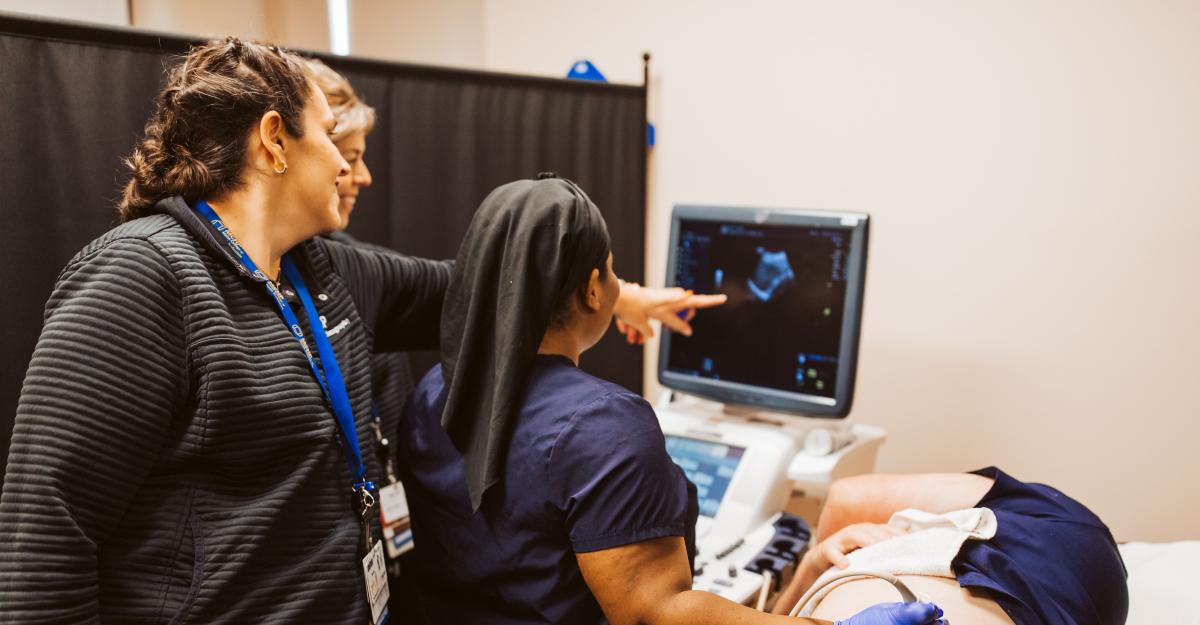
The Advanced Certificate Program in Diagnostic Medical Sonography provides a pathway for individuals seeking to advance their studies in medical imaging. The program offers the knowledge, skills, and abilities necessary to practice sonography and prepares graduates to work as sonographers and function as vital members of the healthcare team.
Upon successful completion of the Diagnostic Medical Sonography program of study at MCHP, the student will have obtained the didactic and clinical prerequisites required to take the physics, abdomen, and obstetrical & gynecological exams through the American Registry for Diagnostic Medical Sonography (ARDMS).
The Advanced Certificate in Diagnostic Medical Sonography is accredited by the Commission on Accreditation of Allied Health Education Programs (CAAHEP) upon the recommendation of the Joint Review Committee on Education in Diagnostic Medical Sonography (JRC-DMS).
The mission of the Diagnostic Medical Sonography Program is to:
- Encourage motivated individuals who are dedicated to pursuing excellence in Diagnostic Medical Sonography.
- Educate individuals to be competent sonographers who demonstrate critical thinking and effective communication skills, highlighting interprofessional collaboration.
- Provide an outstanding education in Diagnostic Medical Sonography.
- Offer educational experiences in the classroom, the campus laboratory, and in a variety of clinical settings with emphasis on exceptional patient care.
Goals
- Students will successfully complete the program.
- Students will successfully pass the ARDMS Sonography Principles and Instrumentation (SPI) examination.
- Graduates will successfully pass the ARDMS Abdomen (AB) examination.
- Graduates will successfully pass the ARDMS Obstetrics and Gynecology (OB/GYN) examination.
- Graduates will become Registered Diagnostic Medical Sonographers (RDMS).
- Graduates will be satisfied with their education.
Learning Outcomes
Minimum Expectations: To prepare competent entry-level sonographers in the cognitive (knowledge), psychomotor (skills), and affective (behavior) learning domains for the abdominal sonography-extended and obstetrics and gynecology concentrations.
- Execute effective communication
- Students will assess non-verbal, verbal, and written communication techniques based on patient care situations (Evaluate)
- Students will evaluate non-verbal, verbal, and written communication techniques to enhance team functionality (Evaluate)
- Demonstrate professionalism
- Students will demonstrate ethical behavior and professional demeanor as outlined by the SDMS (Apply)
- Students will investigate continuing education requirements (Analyze)
- Students will compare resources for professional development (Evaluate)
- Determine the needs of diverse populations
- Students will reflect on their biases and ways to mitigate the potential negative effects to promote quality patient care (Evaluate)
- Demonstrate critical thinking and metacognition
- Students will assess their exam practices to meet the needs of each patient. (Evaluate)
- Students will evaluate ultrasound images for quality and clarity (Evaluate)
- Students will assess prior imaging in different modalities to better evaluate the patient (Evaluate)
- Demonstrate clinical competency
- Students will produce quality ultrasound images (Apply)
- Students will determine the appropriate protocol based on patient considerations, safety, and provider order (Evaluate)
Note
*DMS 420 may be taken to sit for the American Registry for Diagnostic Medical Sonography (ARDMS) Breast (BR) specialty exam, which can result in extra credentials.
**DMS 430 may be taken to sit for the American Registry for Diagnostic Medical Sonography (ARDMS) Vascular Technologist (VT) specialty exam, which can result in extra credentials.
Qualifications for Certification
Individuals may become Registered Diagnostic Medical Sonographers (RDMS) by passing the Sonography Physics and Instrumentation (SPI) examination in addition to one specialty examination (Abdomen (AB) or Obstetrics and Gynecology (OB/GYN)) offered by the American Registry for Diagnostic Medical Sonography (ARDMS).
A Registered Diagnostic Medical Sonographer is educated in the “art and science” of creating medical images of internal structures using high-frequency sound waves.
Diagnostic Medical Sonographers are essential members of the healthcare team who work closely with physicians to provide high-quality patient care. They perform diagnostic ultrasound examinations in a variety of clinical settings, including hospitals, imaging centers, and physician offices. Sonographers use specialized equipment to capture images that assist physicians in evaluating and diagnosing a wide range of medical conditions.
There is a strong demand for Diagnostic Medical Sonographers, and a career in this field offers many opportunities for growth. Sonographers may choose to pursue further education to advance into roles in education, management, or research. Because the need for qualified sonographers exceeds the current supply, job prospects are excellent, and salaries are often higher as a result.